


A review of the Fujifilm XF 23mm F2.8 R WR lens
For me, the most noteworthy aspect of the new Fujifilm XF 23mm F2.8 R WR lens is that it provided sufficient motivation for me to compose a gear review. Many photographers that know me are well aware that I would be the last person to rush out to purchase the latest and greatest camera gear. There are only 2 instances of this occurring during my 30 year photography career. The first was when I decided to switch to the Fujifilm system back in 2012 with the iconic X-Pro1 body and 35mm f1.4 R lens. The second was when I purchased the lens of this review. As many photographers that have toured with me on our photo tours and workshops can attest, I have been a loyal Fujifilm fan since the mirrorless system was introduced, and in particular of the hybrid viewfinder models found in the X-Pro and X100 series.
 In fact, the closest to what I would consider writing a camera or lens review would be an overview of all the Fujifilm products I have owned, as outlined in the December 2022 issue of X Passion Magazine and the March 2023 issue of Fujilove Magazine. Both articles are more what I would consider “real-world” reviews after using the products for a significant period of time, rather than technical reviews of pixel-peeping brick walls. Despite using a variety of camera brands over the years, the fact that I have only discussed my thoughts on the Fujifilm brand is testament to how important the system is in my own photography.
An alternative to the XF 27mm F2.8 R WR
With the release of the updated and improved version of the 27mm F2.8 pancake lens, I was tempted to get one due to it’s portability, allowing me to still fit three bodies with prime lenses of different focal lengths into my Billingham Hadley Large bag. Thankfully I decided against the idea due to the focal length of that lens. For me, a 40mm full frame equivalent is simply too wide, yet not wide enough. For photographers that only use one camera body with only one lens, I can definitely see a good argument for owning the 27mm F2.8. It would be an excellent choice for travel, environmental portraits and street photography. That however, is simply not the case for me. The 35mm [full frame equivalent] focal length is at the limit of my preferred angle of view.
You might say that this tiny XF 23mm F2.8 R WR pancake lens is the one I have been waiting for since entering the Fujifilm X system. The 23mm APSC [35mm full frame equivalent] focal length is undoubtedly the ideal perspective for my type of photography. Up until now I have been using the X100 series cameras with their built-in 23mm lens. While I have been very happy with the overall performance and user experience of the X100 cameras, the tradeoff was that I always felt that they were a bit cramped for holding and making adjustments. The dials, buttons and handling were just a bit too small to be comfortable in my hands.
The XF 23mm F2.8 R WR on an X-Pro2
This is where the X-Pro2 enters the frame. What a perfect sized camera body this is. While there have been minor changes to the body in each iteration, the same nuts and bolts ethos continues in each model. The weight and size is ideal for my type of shooting. It is very well built, so has some heft to it, does not feel hollow, and forgoes all the clutter found on many other mirrorless cameras. In short, the X-Pro series were designed for, and loved by purists.
Combining a Fujifilm X-Pro2 with the XF 23mm f2.8 R WR lens is a remarkable combination for the street photographer. Using this tiny pancake lens is a revelation when comparing it to the size and heft of the 23mm f1.4 variants. And I never really connected with the f2 version. While a tiny lens hood is included, I decided to forgo that as I do use a lens cap when travelling. Swapping between the two is an awkward experience. Instead, I designed and 3D printed a lens hood with combined focus tab that fits on the focus ring and turns as you focus. The manual focus ring is simply too narrow for my use, and all my cameras are set up for AF + MF override, so that I can quickly gain focus if a lens starts to hunt in a low contrast scene.

For street photography in particular, the lens ergonomics and usability has been improved significantly with this DIY lens hood. I also really appreciate the solid clicks at third stop intervals of the aperture ring on this lens. I wish that some of my other Fujinon lenses had this feeling of assurance where the aperture setting would not change accidentally while in the camera bag. Likewise the aperture lock could be useful for some, though personally I never felt the need to use it myself. When overriding autofocus with the AF + MF setting, the image zooms in to the AF selection square as soon as you touch the focus ring. Combined with focus peaking, the lens includes a new high frequency position detector that allows accurate focussing with fewer rotations. I really appreciate that feature. While many may look at this tiny lens with it’s modest F2.8 aperture and dismiss it immediately, some like myself will de delighted with the size, weight, and most importantly, results.
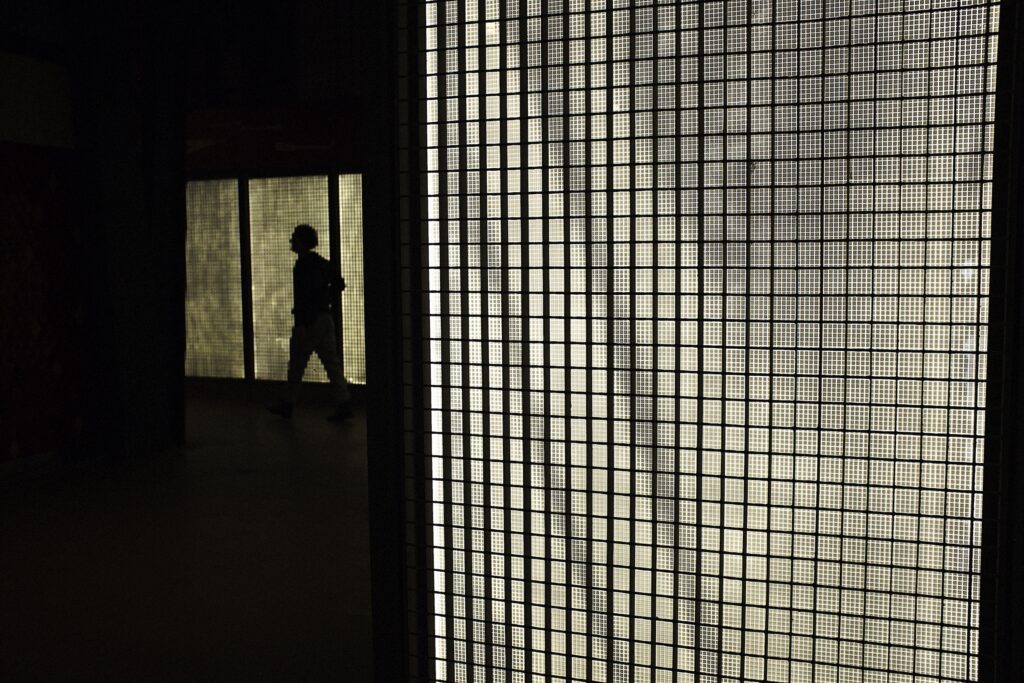
Fujifilm XF 23mm F2.8 R WR for street photography
Discreet street photography where being invisible, or at the very least, not taken seriously as a professional photographer, are what makes this 23mm F2.8 pancake lens so compelling. I am glad that Fujifilm decided to add a lens hood and the tiny lens cap, though I would have appreciated the inclusion of a 39mm UV protection filter – these are not always the easiest size filters to find. Obviously, this lens will not be ideal for night photography or for creating extreme shallow depth of field. But that would be missing the point of what this lens was designed for. Unlike the F1.4 version, the weight and size of this lens are it’s main attributes.
I have a particular setup when it comes to each of my cameras, and each camera body has a prime lens attached according to the subject I aim to capture. In full frame terms, a 21mm is used for architecture, landscapes and negative space. A 35mm is used primarily for street photography and environmental portraits. A 50mm is generally used for half length portraits and low light shooting, while a tele-zoom covers a variety of subjects. If I only go out with one camera, it will always have a 35mm [in full frame terms] lens attached.
For a 23mm lens setup I use 3 different Auto ISO settings, though the most used setting has a minimum shutter speed of 320/sec. and maximum ISO of 3200. This is why I felt it less important to have IBIS when used with this focal length, though I guess IBIS would be most useful when capturing video [though I only shoot stills]. I tend to stick with evaluative metering, mostly shoot in aperture priority at around F8, use the AF + MF option, shoot in burst mode and tweak my exposure with exposure compensation. And that’s it!
An alternative to the X100 series
Without trying to bore you with which camera settings I use at this focal length, I feel it is important to know where I am coming from in terms of what I need from a lens. For example, shooting in the F5.6 – F11 range gives me sufficient depth of field for contextual photography while taking advantage of the best image quality possible. That’s why I was never really bothered about the earlier X100 models that suffered softness when shooting close and wide open. Likewise, I simply don’t shoot at large apertures in this focal length, so why would I want to carry a large, heavy, fast lens? Not to mention the attention it would bring when trying to be inconspicuous.
Apart from the smaller size of the X100 bodies mentioned earlier, the only features of that camera that I miss are the built-in ND filter and the leaf shutter. Using these 2 features combined with the built in flash can be quite addictive. But the handling of the X-Pro2 with this new 23mm lens way outweighs those great features. One must also not overlook the fact that using an interchangeable camera body is far more versatile in having the option to change a lens for any given scenario. Throw in the great build quality, size, weight and 7 point weather sealing on the lens, makes this a winning combination.

Image quality of the Fujifilm XF 23mm F2.8 R WR and conclusions
I am not one for delving into every technical detail when choosing camera equipment, but this lens really does tick almost every box for my purposes. Apart from the physical size, handling and build quality, the optical characteristics are solid. Most photographers will search for sharpness tests online to know if it is worth continuing to delve deeper. While the centre and corner sharpness is lower wide open, it is very sharp from F4 – F11, and tack sharp in both the centre and corners at F8. It handles shooting into the light without flare issues, contrast and colour rendition is excellent, bokeh and fall off are visually pleasing, vignetting is virtually non-existent, chromatic aberrations are very well controlled, and lens distortion seems to be nowhere in sight.
So what’s not to like? While they are not deal-breakers for me, I would have liked a wider manual focus ring and a linear focus motor. But these would have made the lens more bulky which defeats the reason for buying it in the first place..

I believe that when a great product enters the market, there isn’t all that much else that one needs to say about it – just go out and enjoy shooting with it! I have no doubt that there will be many reviews and recommendations when this lens is sold as a standalone product in December 2025. Until then, it can only be purchased as part of a kit with the new X-E5 camera – a combination that I have no doubt will satisfy many new owners. For those that are weighing up the idea of buying this lens to substitute an X100VI or earlier X100 series camera, or for those that want a lighter, more compact and more inconspicuous version of the F1.4 and F2 offerings, this XF 23mm F2.8 R WR lens will not disappoint.
Squarehood for the Fujifilm XF 23mm F2.8 R WR
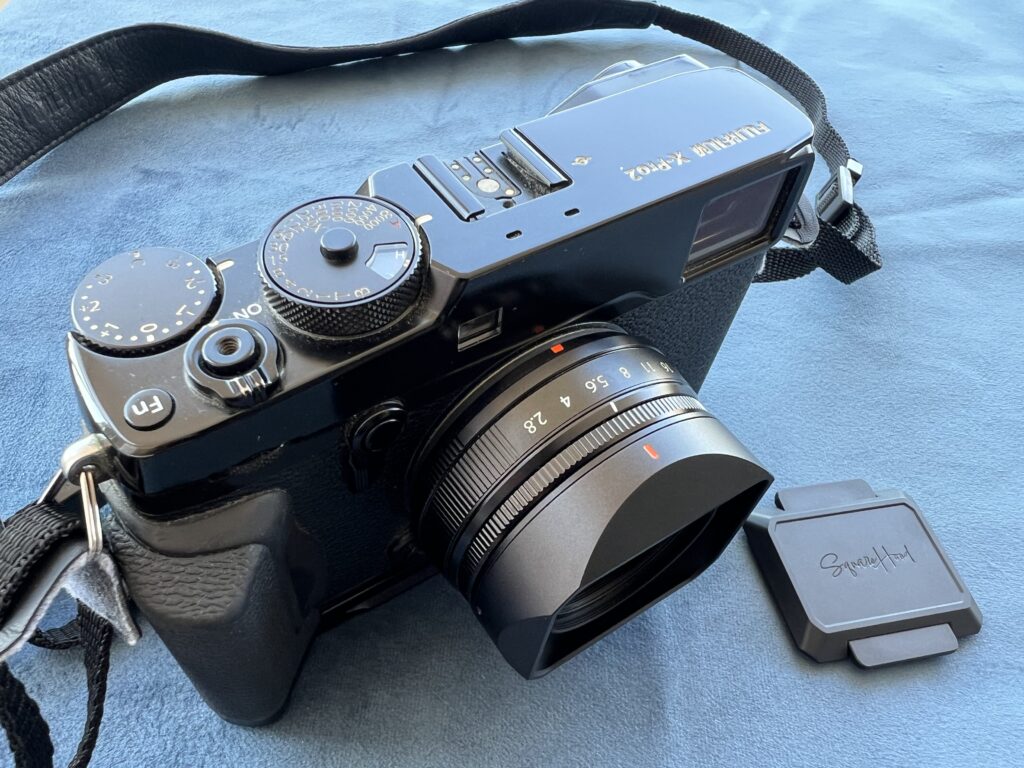
In order to keep the Fuji 23mm f2.8 lens on the X-Pro2 as compact and discreet as possible, I decided to forgo the 3D printed lens hood, and order a Squarehood from the Swedish manufacturer in the summer of 2026. Made from aluminium throughout, the Squarehood comes in 2 parts, and can be disassembled by loosening the tiny Allen screws. The mounting adapter screws on to the filter thread of the lens before screwing on the lens filter [I use the 39mm Rodenstock UV Super MC]. You then screw on the Squarehood to the adapter, line up the red location mark to the lens and tighten the Allen screws.
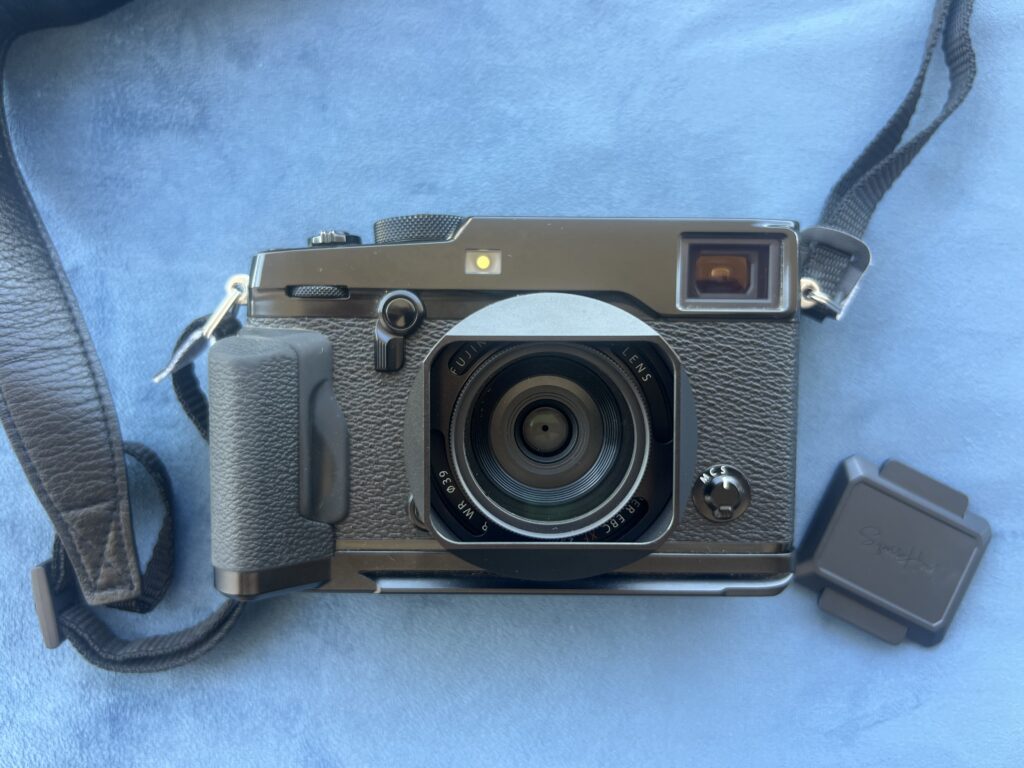
Personally, I feel that this is the best quality and design in any lens hood I have used to date. It really feels like it gels with the lens seamlessly, and just feels right. The Squarehood also comes with a pinch-style lens cap. I really love this setup! Due to the lens design, lens hoods need to be attached to the filter thread, as there is no bayonet mount on the lens barrel. This can be a concern for owners that might bump the lens hood, but due to the compactness and low profile of this hood, any damage to the lens seems to be reduced. This was also one of the reasons that I forgo my 3D printed lens hood, which increased the diameter of the setup.
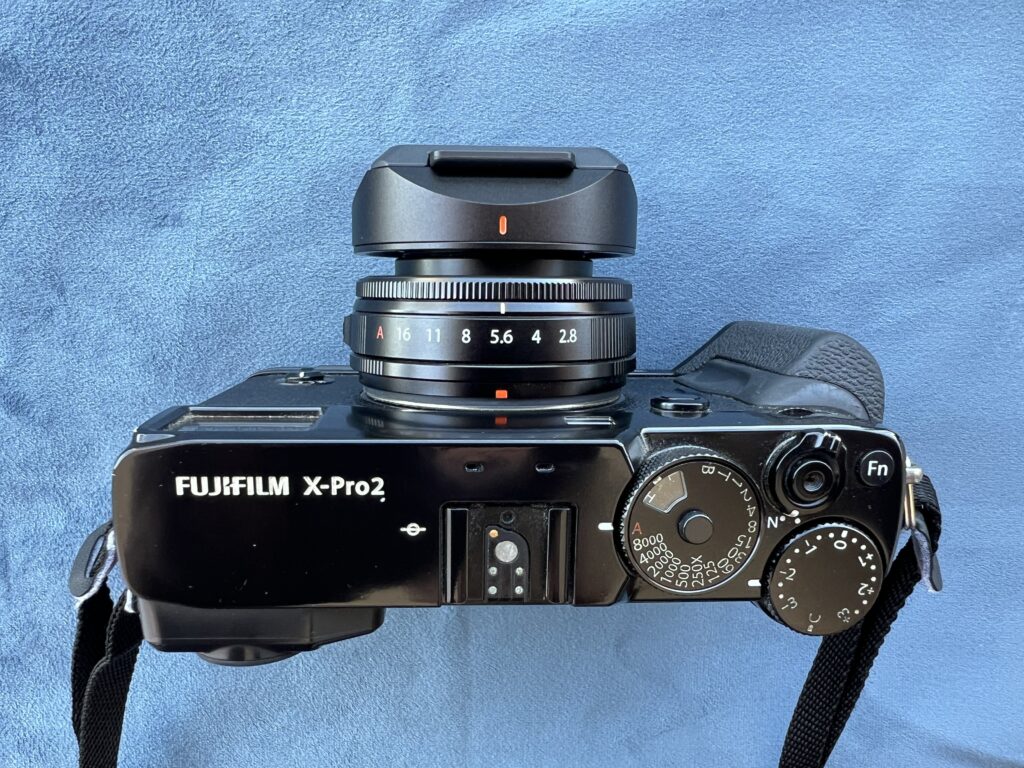
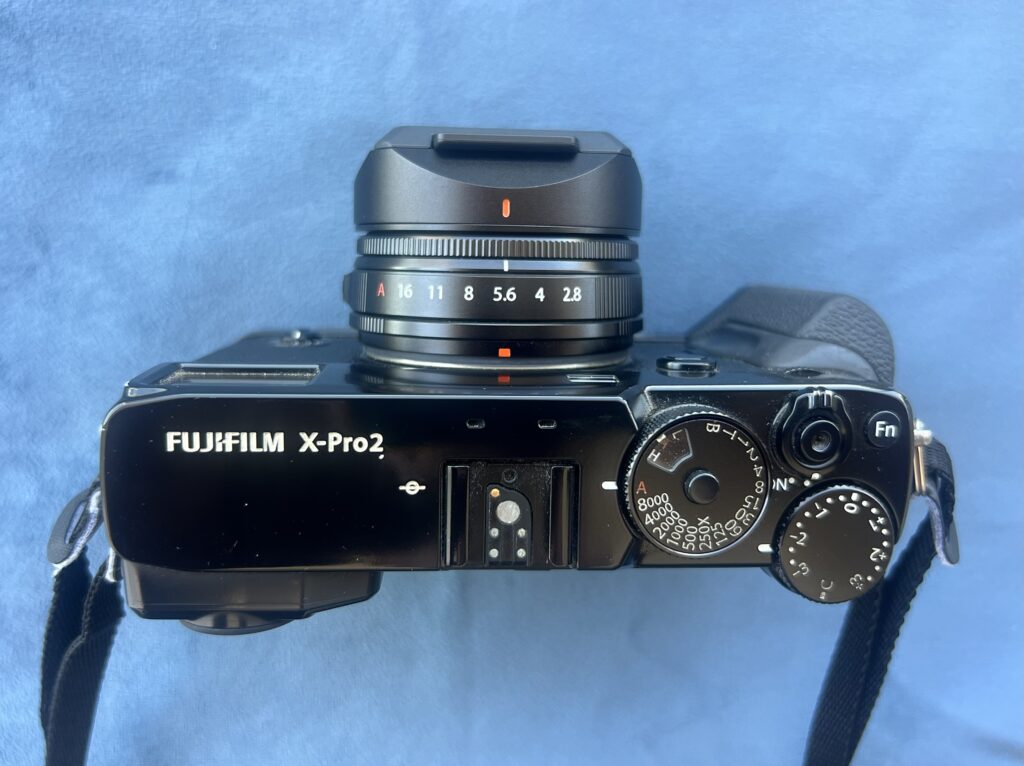
In order to keep its compact size, the 23mm f2.8 lens does not have an internal focussing system. This means that the lens protrudes in and out when turning the camera on and off, and when focussing. The Squarehood was designed perfectly to accommodate this feature, and unlike some other square hoods from other manufacturers, does not interfere at all with focussing due to the machined tolerances and narrow profile. The top image above shows the lens when it is extended. The bottom image shows the lens when the camera is turned off. While this lens hood was the most expensive [shipping cost more than the lens hood itself], I am very pleased with this product.